
Agent engines
Use the agent subscriptions and CLIs you already have.
Dash Bot does not proxy every message through its own model account. It starts supported agent CLIs on your computer and normalizes their output through the local harness.
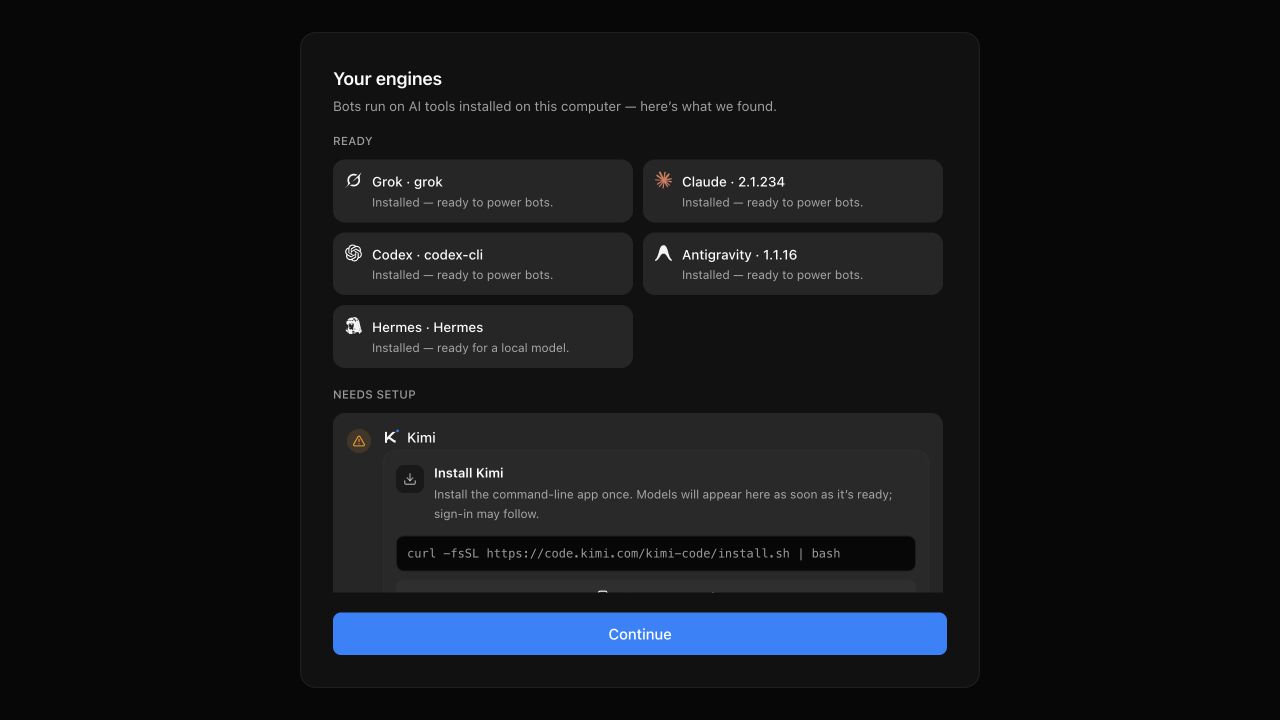
Built-in engines
| Engine | Authentication shape | Notes |
|---|---|---|
| Claude | Claude CLI login | Strong support for tools, approvals, sessions, and local computer use |
| Codex | Codex CLI login | Model discovery, approvals, steering, and computer tools |
| Grok | Grok CLI login | ACP-based local model catalog and session support |
| Cursor | Cursor Agent CLI login or API key | ACP driver with live model discovery |
| Kimi | Kimi CLI login | ACP integration |
| Droid | Factory Droid CLI login | ACP integration |
| Antigravity | Google Antigravity CLI login | Default Google consumer engine |
| OpenCode Go | OpenCode login | ACP integration |
| Qwen | Qwen CLI login | ACP integration |
| Hermes | Hermes CLI login | ACP integration |
| Pi | Pi CLI login | Native driver |
Additional driver instances can be declared in local configuration. Unavailable engines remain visible with a reason instead of crashing the provider fleet.
Detection
Dash Bot checks common installation directories and the login shell in the background. Restart the app after installing or authenticating a CLI.
If detection fails, use Settings → Engines to set an explicit executable path. This is supported for every engine and is the most reliable solution for version managers, wrappers, custom builds, and Windows installations outside the normal path.
Model selection
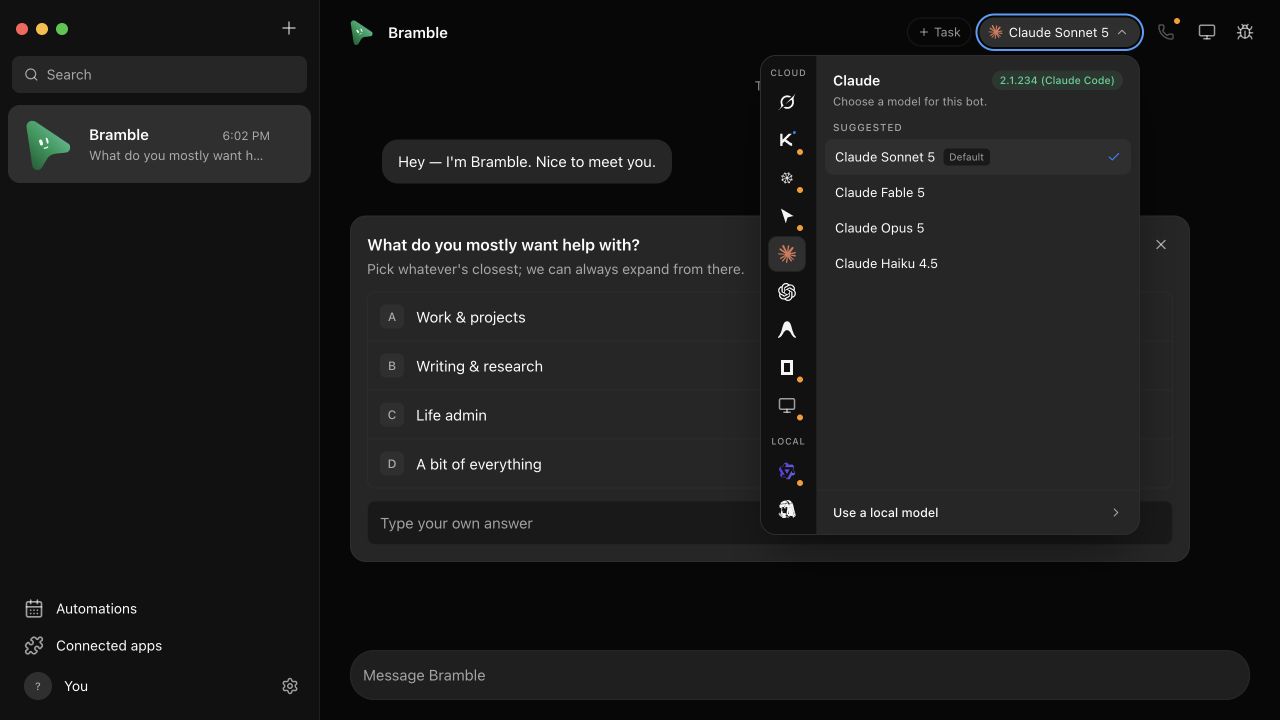
The model picker groups models by provider and marks defaults. Supported engines can refresh their model catalog from the installed CLI. Changing the model affects future turns; it does not rewrite earlier transcript history.
Subscriptions stay with the provider
Your existing CLI login or provider API key determines access and billing. Dash Bot does not turn one subscription into access to another provider.